
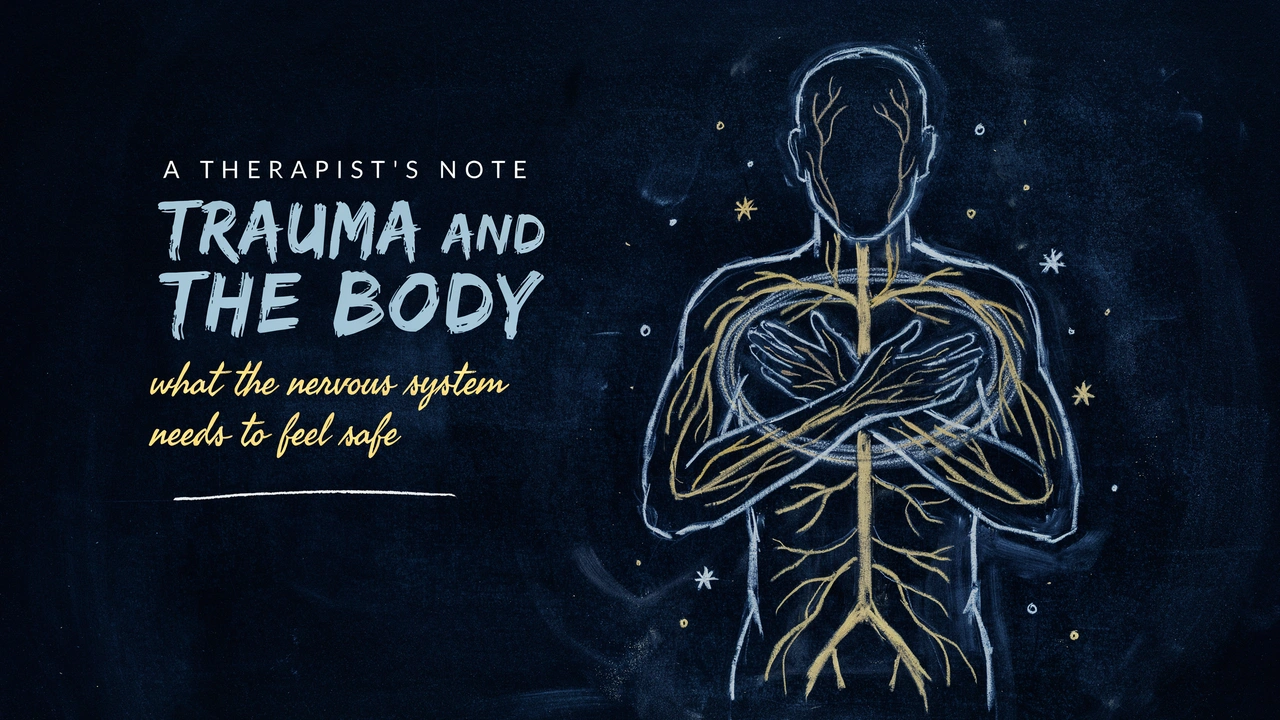
Trauma and the body: what the nervous system needs to feel safe
Trauma can quite literally take up residence in the body. A look at the mind–body connection, what our nervous system needs to feel safe — and how, as practitioners, we can support it.
Ask a client where they feel it, and they will rarely point at their head. They point at the chest, the stomach, the throat. Trauma is remembered as much in the body as it is in the story, and a practitioner who works only with the narrative is working with half the material.
The body keeps the appointment
When something overwhelms our capacity to cope, the nervous system does what it was built to do: it mobilises. Heart rate climbs, breathing shortens, muscles brace, digestion pauses. That response is not a malfunction — it is a competent system doing its job under pressure. The difficulty is what happens afterwards. If the threat never resolved cleanly, the body can stay part-way through the response, braced for something that has already happened.
Clients describe this as being permanently on edge, or as a flatness they cannot explain. Both are the same system stuck: one foot on the accelerator, or a foot pressed hard on the brake. Neither is a choice, and neither responds well to being argued with.
Safety is not something we can talk a client into. It is something their nervous system has to conclude for itself — and our job is to make that conclusion easier to reach.
What the nervous system is actually looking for
Three things, repeatedly: predictability, a sense of agency, and connection. Predictability is why we say at the start of a session what we are going to do, and then do that. Agency is why we ask permission before every shift — and mean it when we say the client can stop. Connection is the least technical and the most powerful: a steady, unhurried practitioner is itself a regulating presence.
None of this is exotic. It is the reason the ordinary parts of practice — the same room, the same greeting, the same closing ritual — carry more therapeutic weight than they appear to. Repetition is not filler; it is evidence.
Stabilisation before processing
The most common error in trauma work is going too fast. A client who can describe an event without becoming overwhelmed is not necessarily ready to reprocess it. Before any of that, they need reliable ways back to calm that work outside the therapy room: grounded breathing, orienting to the present, a safe-place resource they have practised when they did not need it.
In hypnotherapy this changes the order of the work. Induction becomes lighter and more collaborative, eyes-open options stay available, and depth is treated as the client's decision rather than the practitioner's goal. Where regression is used at all, it is used late, briefly, and with an agreed exit.
Knowing your edge
Some presentations belong with a clinical psychologist, a psychiatrist, or a trauma specialist working within a medical team — and recognising that early is part of practising well. Complex or repeated developmental trauma, active dissociation, current risk: these are moments to liaise, refer, and stay in your lane while remaining useful.
This is also where supervision earns its place. Trauma work has a way of accumulating quietly in the practitioner. Bringing the case to supervision is not an admission that it went badly; it is how you keep doing the work for years rather than months.
Where to start
If you take one thing into your next session, make it pace. Slow down the beginning, spend longer than feels necessary on resourcing, and let the client set the depth. The processing will come, and it will hold better for having been built on a floor the nervous system trusts.

Lisa Williams Edgar
Founder, Director & Senior Trainer · HPD, MNCH (Acc.), NCH Sup, SFBT Sup Hyp
Qualified Clinical Hypnotherapist, Senior Lecturer and Supervisor in Integrative Clinical Hypnotherapy, with additional training in psychotherapy, CBT skills and NLP. Practical and focused on building ethical professional identity.
Meet the Founders →More from the blog
Notes on clinical practice, professional development and the realities of the therapy room.

Being Comfortable with Silence
Two women walking along a beach in Cape Verde with the words “Let’s be comfortable for a while with silence”, illustrating a New Horizon Training Academy reflection on therapeutic silence in hypnotherapy practice.

Energy Psychology & EFT: The Science Behind the Tapping (And Why It’s Not Just Woo) By Angie | New Horizon Training Academy
Energy Psychology & EFT: The Science Behind the Tapping
Spring Blog: Solution Focused Hypnotherapy and Borderline Personality Disorder (BPD)
Understanding Borderline Personality Disorder (BPD)