
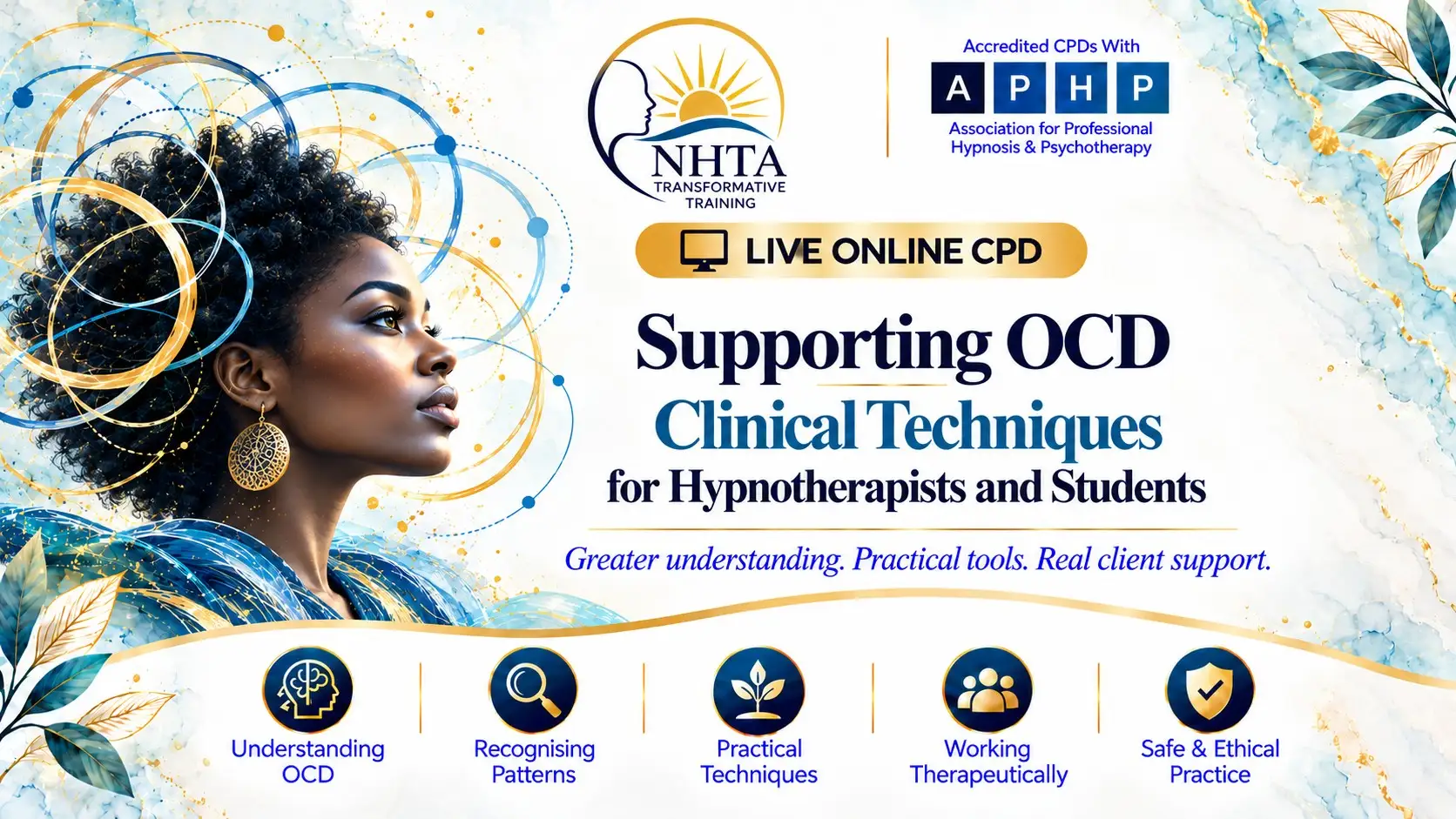

Supporting OCD: Clinical Techniques for Hypnotherapists and Students
Feel more confident supporting clients with OCD, Pure O and intrusive thoughts. Join Lisa Williams Edgar for a practical CPD exploring hidden compulsions, reassurance seeking and safe, effective Solution Focused and Integrative Hypnotherapy approaches.
- Date
- Friday 19 March 2027
- Time
- 09:30–16:30 (Europe/London)
- Delivery
- Online (Zoom)
16 places left
Supporting OCD: Clinical Techniques for Hypnotherapists and Students
A Practical CPD in Solution Focused and Integrative Hypnotherapy with Lisa Williams Edgar
How Confident Do You Feel When a Client Presents with OCD?
Working with Obsessive Compulsive Disorder (OCD) can sometimes feel daunting, even for experienced hypnotherapists.
Perhaps a client tells you they are experiencing frightening intrusive thoughts. Perhaps they repeatedly check things, seek reassurance, mentally review conversations or struggle with thoughts they cannot seem to let go of.
Or perhaps they haven't mentioned OCD at all. They have come to you with anxiety, guilt, repetitive thinking, fear of making mistakes or an overwhelming need to feel certain.
How do you recognise when OCD may be part of the picture, understand what is maintaining the pattern and respond therapeutically without accidentally reinforcing it?
Join Lisa Williams Edgar for a practical, compassionate and thought-provoking CPD designed to help hypnotherapists feel clearer, more informed and more confident when OCD and related patterns appear in their clinical work.
This workshop brings together an understanding of OCD, evidence-informed psychological principles and practical Solution Focused and Integrative Hypnotherapy approaches.
The emphasis throughout is on recognising what is happening beneath the symptoms and understanding how to support clients safely, ethically and appropriately.
Understanding OCD Beyond the Stereotypes
OCD is far more than repeated handwashing or checking whether a door is locked.
For some people, compulsions are clearly visible. For others, they happen almost entirely within the mind.
These less visible presentations, sometimes referred to as Pure O, may involve mental reviewing, rumination, analysing, neutralising, checking feelings or repeatedly seeking certainty.
OCD can also become associated with intrusive thoughts about harm, relationships, morality, religion, responsibility and other deeply personal concerns.
One of the most important things we will explore is that the intrusive thought itself is not necessarily what maintains OCD. It is the pattern of responding to it that can keep the cycle going.
Understanding this distinction can make an enormous difference to how we approach our work.
What Will You Learn?
Throughout this practical training day, we will explore:
Understanding OCD, Pure O and the different ways obsessive compulsive patterns can present.
The OCD cycle and how intrusive thoughts, distress, compulsions and temporary relief can reinforce one another.
Why intrusive thoughts are part of normal human experience and how some become particularly distressing or difficult to dismiss.
Recognising visible and hidden compulsions, including checking, reassurance seeking, mental rituals and avoidance.
Understanding the roles of doubt, uncertainty, shame, guilt and heightened responsibility.
Why repeated reassurance can sometimes strengthen rather than reduce OCD patterns.
How to respond compassionately to distressing thoughts without becoming drawn into the reassurance cycle.
Mapping a client's OCD pattern to understand triggers, responses and maintaining factors.
Exploring practical techniques including Thought Labelling, Notice and Allow, Urge Surfing and Delay and Decide.
Using Prediction Versus Outcome exercises and appropriately planned behavioural experiments.
Understanding exposure-informed principles and the importance of reducing compulsive responses.
Helping clients build greater tolerance of uncertainty and develop more flexible responses.
Using Solution Focused questioning, scaling, strengths, exceptions and future-focused approaches appropriately.
How hypnosis, therapeutic imagery and positive future rehearsal may support change without reinforcing avoidance or compulsive patterns.
Considering OCD where ADHD, autism or other neurodivergent presentations may also be relevant.
Supporting progress, recognising setbacks and developing practical relapse-prevention approaches.
Understanding professional boundaries, ethical responsibilities and when additional or specialist support is needed.
Practical Techniques You Can Use in Your Sessions
This isn't simply a workshop about understanding OCD. It is also about what we can actually do in the therapy room.
We will explore practical tools that can be incorporated thoughtfully into Solution Focused and Integrative Hypnotherapy sessions.
These include helping clients notice the difference between a thought and a response, recognising urges without automatically acting upon them, developing greater flexibility around uncertainty and reconnecting with the activities and values that matter to them.
We'll also look at adapting familiar therapeutic approaches, including the Miracle Question, scaling, client-centred questioning, hypnosis and future rehearsal.
The aim is not to provide a rigid script for every OCD presentation. It is to help you understand the principles behind the techniques so you can make better-informed decisions for the individual client in front of you.
Throughout the day, we will use practical examples, discussion and exercises to bring this learning into everyday clinical practice.
Bringing Hypnotherapy into OCD Work
For hypnotherapists, an important question is understanding where our existing therapeutic skills may contribute and where a different or additional approach is needed.
Hypnosis can be used thoughtfully to support coping, emotional regulation, therapeutic flexibility and positive future rehearsal.
However, OCD requires particular care.
Relaxation must not become another compulsory ritual. Therapeutic reassurance must not unintentionally strengthen the need for certainty. And our interventions must not encourage the client to avoid or suppress every uncomfortable thought.
We'll explore how to use hypnotic language, Solution Focused approaches and integrative techniques in ways that support more helpful responses rather than reinforcing the OCD cycle.
Safe, Ethical Practice and Knowing When to Refer
This CPD does not qualify practitioners to diagnose OCD or replace specialist psychological or psychiatric treatment.
Cognitive Behavioural Therapy (CBT), including Exposure and Response Prevention (ERP), is an established recommended treatment for OCD.
Throughout the workshop, we will consider how an understanding of exposure and response prevention can inform ethical hypnotherapy practice without assuming that attendance at this CPD qualifies practitioners to deliver specialist ERP.
We'll explore when hypnotherapy may be appropriate within an individual's professional competence, when it may complement other treatment and when specialist assessment, referral, supervision or additional support is necessary.
We will also consider the importance of confidentiality, safeguarding, informed consent, professional competence and appropriate therapeutic boundaries.
The intention is to develop greater professional confidence while remaining realistic and responsible about the limits of our role.
Your Comprehensive Practitioner Resources
One of the valuable parts of this workshop is the substantial supporting material you can return to after the training.
Before the workshop, you will receive a reflective preparation workbook to help you consider your existing experience, questions and learning goals.
Following the workshop, you will receive a comprehensive practitioner resource pack and step-by-step guide.
The resource pack includes:
Clear explanations of OCD patterns and maintaining cycles.
Practical therapeutic tools and step-by-step guidance.
Examples of helpful client language.
Guidance on adapting Solution Focused sessions for OCD presentations.
OCD pattern mapping and assessment questions.
Client worksheets and check cards.
Behavioural experiment and prediction-versus-outcome planners.
Guidance on reassurance, uncertainty, rumination and hidden compulsions.
Exposure-informed principles and professional considerations.
Case examples and practitioner reflections.
Session planning and relapse-prevention resources.
Solution Focused trance scripts and guidance on adapting hypnotic language.
These are designed to become useful working resources that you can revisit and adapt appropriately within your own clinical practice.
Who Is This Workshop For?
This CPD is suitable for qualified hypnotherapists, student hypnotherapists and practitioners with an interest in developing their understanding of OCD within Solution Focused and Integrative Hypnotherapy.
It is particularly valuable if you:
Feel unsure about supporting clients with OCD or Pure O.
Want to understand hidden compulsions and reassurance-seeking patterns more clearly.
Would like practical tools to bring into your existing therapeutic approach.
Want greater confidence in recognising when additional or specialist support is necessary.
Have already worked with OCD presentations and would like to refresh or deepen your clinical understanding.
You do not need to have specialist OCD training to attend, although the workshop does not replace training or supervision needed for work beyond your current competence.
Meet Your Trainer
Lisa Williams Edgar is the Founder of New Horizon Training Academy, a Clinical Integrative and Solution Focused Hypnotherapist, Senior Lecturer, Trainer and Registered Supervisor.
Lisa brings extensive professional experience and practical clinical understanding to her workshops.
Her teaching combines clear explanations, real-world examples, supportive discussion and practical techniques that practitioners can adapt within their own work.
She is particularly passionate about making complex clinical subjects easier to understand while encouraging safe, ethical and compassionate therapeutic practice.
What Have Previous Participants Said?
"I think the course was fantastic. So much information, and Lisa was ALWAYS welcoming of questions and input from attendees."
Charlotte Grayson
Previous participant, Supporting OCD CPD
What's Included?
Full-day live online CPD with Lisa Williams Edgar.
Clear, practical teaching and guided discussion.
Clinical examples and therapeutic techniques.
Opportunities for questions and reflection.
Pre-workshop preparation workbook.
Comprehensive post-workshop practitioner resource pack.
Workshop presentation slides.
APHP accredited CPD certificate of attendance.
Workshop Information
Date: Friday 19 March 2027
Time: 9.30am–4.30pm (UK time), including comfort and lunch breaks.
Delivery: Live Online via Zoom
Investment: £125 per person
APHP Accredited CPD
New Horizon Training Academy is an NCH Accredited School and an APHP Accredited CPD Provider.
Leave feeling better informed, more confident in your professional boundaries and better equipped with practical, compassionate and ethical approaches for supporting clients when OCD becomes part of the therapeutic picture.
Other CPD you might pair with this
 Addiction & dependency
Working With Addiction and Dependency Patterns
Clearer boundaries, better questions and safer practice when clients disclose alcohol, drugs or other dependency-related coping patterns in hypnotherapy work.
 Children & SEN
Understanding SEN for Hypnotherapists (Children & Teens)
With Brad Smith: equipping solution-focused and integrative hypnotherapists to work effectively with children and young people with SEN, including Autism and ADHD.
 Trauma in young people
Trauma in Children and Adolescents for Hypnotherapists
Supporting emotional healing in young people — understanding trauma responses in children and adolescents, and practical tools for safe, empowering hypnotherapy work.

Supporting OCD: Clinical Techniques for Hypnotherapists and Students
19 Mar 2027 · 09:30–16:30 · Online (Zoom). If you would like to know more before booking, just get in touch.
16 places left