Clearer boundaries. Better questions. Safer practice.
Would you know how to respond if a client disclosed that alcohol use, drug use, or another dependency-related pattern had become part of the way they switch off, manage emotions, escape stress, or get through the week?
Many hypnotherapists will encounter clients where alcohol use or drug use forms part of the wider presenting picture. Others may also disclose gambling, compulsive online behaviours, compulsive shopping, or other repetitive coping patterns that follow similar loops of relief, reward, shame, avoidance and repetition.
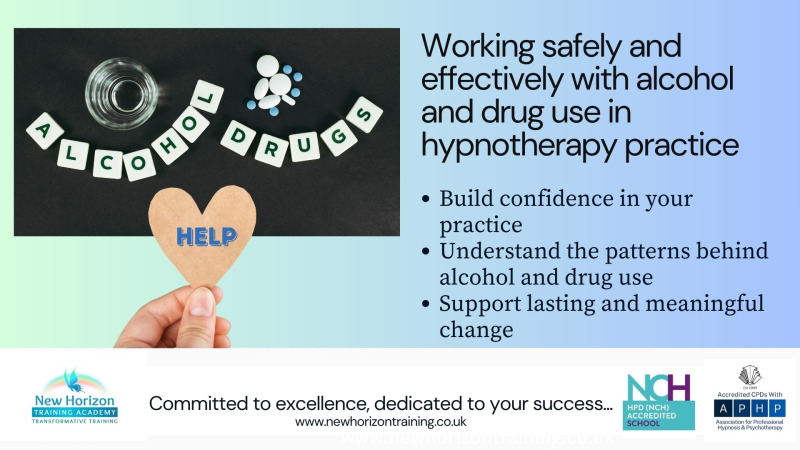
This practical and thought-provoking half-day workshop has been created to help hypnotherapists and students feel clearer and more confident when alcohol use, drug use, dependency, or compulsive coping patterns show up in the therapy room.
This half-day CPD is designed as a practical, scope-aware introduction to working safely with alcohol use, drug use and dependency-related patterns in hypnotherapy practice. It does not train practitioners to diagnose addiction, manage detox, provide rehab, or work outside their professional competence. The focus is on safer assessment, clearer boundaries, appropriate referral, therapeutic language, and hypnotherapy tools that can support change where this work sits safely within scope.
This workshop does not train practitioners to diagnose addiction or manage medical withdrawal, and clear guidance around referral, safeguarding, and professional boundaries will be discussed throughout.
Drawing from an integrative and solution focused hypnotherapy perspective, this training will explore how to work with the underlying patterns that can keep clients stuck, including repetition, relief-seeking, shame, avoidance, and behavioural loops.
You will also gain a simple and practical understanding of why addiction and dependency-related patterns can become so difficult to shift, including the role of habit, reward, learned association, emotional regulation, and the brain’s tendency to repeat what brings short-term relief or escape.
Throughout the workshop, we will stay grounded in clear, realistic, and professional practice, helping you feel more confident in how to approach this area in a way that is useful, thoughtful, and appropriate.
You will also receive a pre-workshop workbook to help you begin thinking about the topic before the day, along with a large post-workshop resource pack filled with step-by-step explanations, tools, techniques, therapeutic language, guidance, and useful resources to support your learning afterwards.
Work More Confidently Within Scope
Gain clarity on what is appropriate to work with as a hypnotherapist when addiction, dependency, or compulsive coping patterns are involved, and feel more confident in how to approach these conversations and presentations.
Understand the Pattern Beneath the Behaviour
Explore why people can become stuck in cycles of use, including habit loops, reward, relief, emotional coping, and the role of repetition.
Know What to Look For
Learn what to pay attention to during the initial consultation, including patterns, red flags, and the wider picture that may be sitting behind the presenting issue.
Use Solution Focused and Integrative Tools More Effectively
Discover practical ways to structure sessions, ask better questions, and use hypnosis more effectively when working with urges, routines, coping patterns, and behavioural repetition.
Leave With Tools You Can Use Straight Away
Come away with practical ideas, therapeutic language, clinical guidance, techniques, and resources that can support your work in both online and face-to-face practice.
What You Will Learn
By the end of this workshop, you will have a clearer understanding of:
- What is and is not appropriate to work with as a hypnotherapist.
- How to recognise red flags and when extra support may be needed.
- How to structure the initial consultation when substance use, dependency, compulsive behaviours, or coping patterns are disclosed.
- How to use solution focused questioning more effectively in this area.
- How to work with urges, routines, coping patterns, and future change using hypnotherapy.
- How to use language and therapeutic tools that support change without confrontation or shame.
- How to feel more confident and grounded when this kind of presentation appears in practice.
What We’ll Cover
- The difference between habit, coping pattern, harmful use, addiction, and dependency.
- How alcohol use, drug use, gambling, compulsive online behaviours, compulsive shopping, and other repetitive coping behaviours can become linked with relief, avoidance, identity, and repetition.
- The role of the brain, reward, emotional regulation, and reinforcement in repeated behaviours and use patterns.
- What to notice and explore during the initial consultation.
- Solution focused questions that are genuinely useful in this work.
- Why shame, secrecy, and all-or-nothing thinking can keep clients stuck.
- Hypnotherapy approaches for urges, routines, future self-work, and behavioural change.
- Language patterns and therapeutic phrasing that support change without confrontation.
- Practical ideas to take straight into your client work.
Who Is This Workshop For?
This half-day workshop is suitable for:
* Qualified hypnotherapists.
* Student hypnotherapists.
* Solution focused hypnotherapists.
* Integrative practitioners who would like a clearer, more confident framework for working with addiction, dependency, compulsive coping, and substance-related presentations.
Your Trainer
This workshop is delivered by Lisa Williams Edgar, Founder of New Horizon Training Academy, Integrative and Solution Focused Clinical Hypnotherapist, Supervisor, and Senior Lecturer.
Lisa is known for delivering training that is practical, warm, grounded in real client work and personal experience, and designed to help therapists feel more confident in the therapy room without overcomplicating the process.
Her teaching style is clear, engaging, and focused on giving practitioners tools and understanding they can genuinely take back into practice.
A Thoughtful and Grounded Approach
This workshop has been designed to help practitioners understand how hypnotherapy can support clients when alcohol use, drug use, compulsive coping behaviours, or dependency-related patterns are tied to habit, coping, emotional regulation, routine, or behavioural repetition.
When used well and within appropriate professional boundaries, hypnotherapy can support meaningful shifts in awareness, motivation, self-control, emotional resilience, and future-focused change. It can help clients move away from automatic patterns and towards a stronger sense of choice, agency, and possibility.
This training will help you apply hypnotherapy more confidently and effectively in this area, using an approach that is practical, grounded, ethical, and deeply relevant to real client work.
Please note: smoking and vaping can, of course, involve strong addictive and dependency patterns. New Horizon Training Academy covers smoking and vaping cessation within a separate dedicated CPD, as these presentations often benefit from a more specific structured cessation approach. This workshop may briefly reference smoking and vaping where relevant, but the main focus is on alcohol use, drug use, gambling, compulsive coping behaviours, dependency-related patterns, professional boundaries, referral considerations, and safe integrative hypnotherapy practice.